

free. fun. effective.

Bringing the Joy and Rigor of Learning to the Lifelong Skill of Math

Helping Duolingo Maths Users to Learn anytime, anywhere

free. fun. effective.

Bringing the Joy and Rigor of Learning to the Lifelong Skill of Math

Helping Duolingo Math Users to Learn anytime, anywhere

CONTEXT

Math Anxiety: Math Practice Breaks Early

Whether you’re studying fractions in the classroom or calculating the tip at a restaurant, math is a key part of our daily lives. But that doesn’t mean people are comfortable using math every day! In fact, many people experience stress when faced with math-related situations, which is known as “math anxiety”1.

Recent studies found that a third of UK adults have experienced at least some math anxiety, and parental maths anxiety influences children’s mathematical development over time.

In this case study, I aimed to launch a product in the UK market to enable children between the ages of 3 and 11 to overcome math anxiety by making math fun and effective.

This feature is not a substitute for the existing formal education curriculum, nor is it an assessment, grading, or exam preparation tool.

HYPOTHESIS

If we make Duolingo Math accessible and fun, it will become a natural learning habit for everyone, increasing retention among our user base.

MARKET PROBLEM

The core problem is not access to maths content, but the breakdown of consistent, confidence-building practice.

 Child Tension (User)

  • Maths feels frustrating or boring
  • Avoidance reinforces low confidence
  • Practice is associated with pressure

Observed Market Reality

  • Maths anxiety and avoidance emerge early
  • Practice outside school is inconsistent
  • Homework often creates friction rather than confidence

Parents (Enabler)

  • Parents invest in tutors and tools
  • Child’s daily practice still requires nagging
  • Value of paid support is diluted without consistency

Primary Business Objective​

Increase student usage and engagement for Duolingo Math among primary learners (Grades 2–6).

    What GTM Is Accountable For?

  • Driving consistent maths practice
  • Enabling habit formation
  • Ensuring value is observable by parents

       What GTM Is Explicitly Not Optimising For?

  • Immediate revenue
  • Curriculum adoption
  • Institutional sales

PRODUCT READINESS

What Duolingo Math can and cannot credibly promise in the UK market?

PRODUCT READINESS

What Duolingo Math can and cannot credibly promise in the UK market?

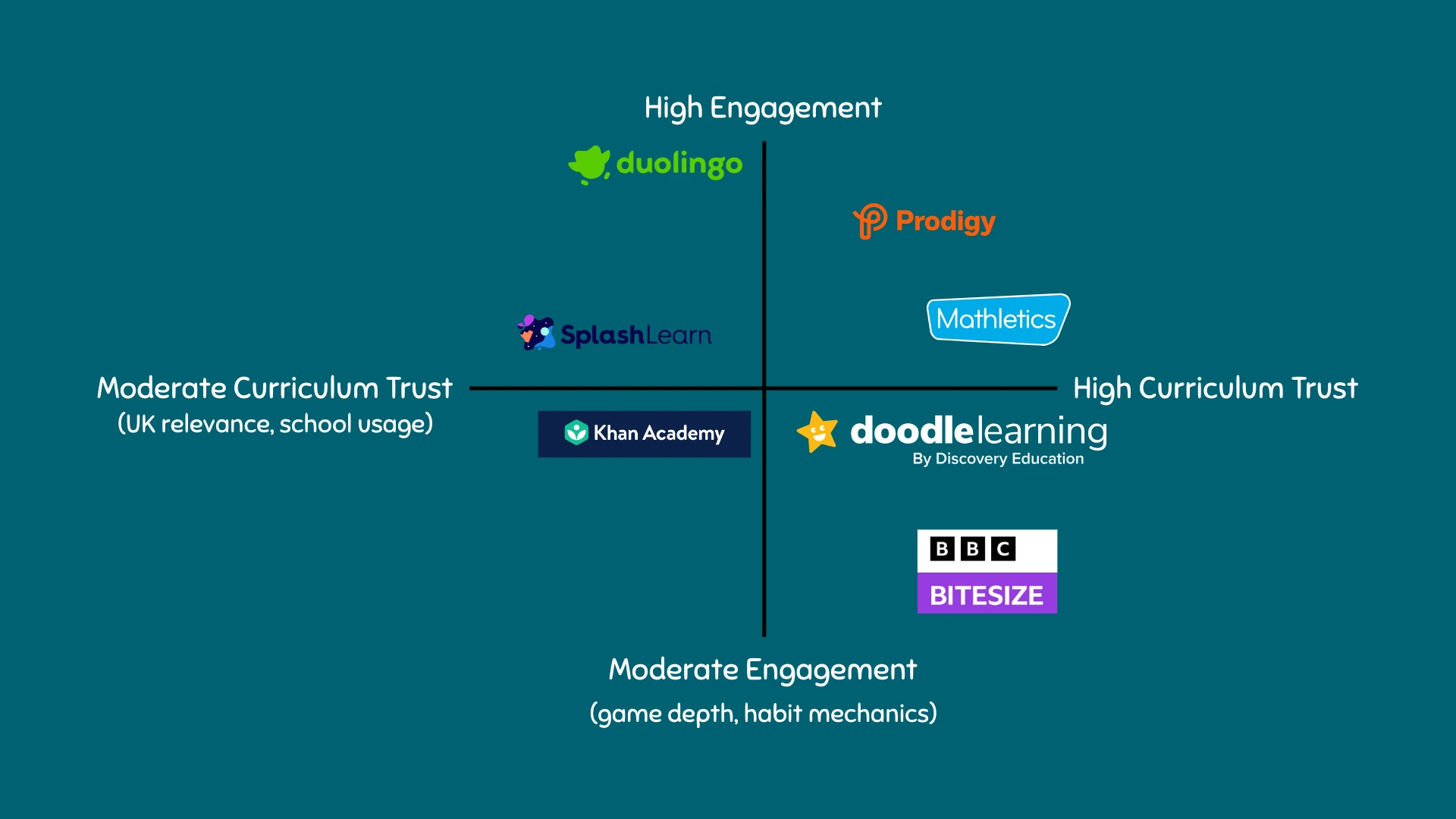
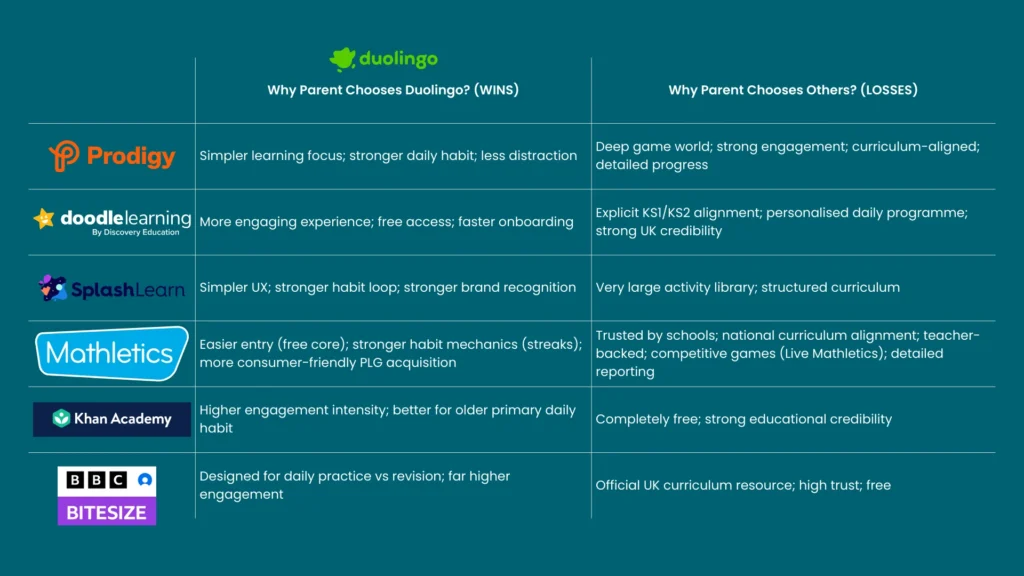
Competitive Landscape

How Duolingo Math wins and loses in the real market, not in feature comparisons?

Ideal Customer & Consumer Profile

Who the GTM is explicitly built for, and just as importantly, who it is not for?

Highly involved parents of children aged –11 in the UK.

  Buying Group Dynamics

  • Buyer: Parent
  • User: Child
  • Validator (indirect): Teacher


Defining Characteristics

  • Already paying for tutors or learning apps
  • Actively monitoring academic progress
  • Willing to invest to prevent learning gaps
  • Seeking reinforcement, not replacement, of tutoring


 Explicit Non-ICP

  • Parents seeking only free tools
  • Parents looking for specific curriculum-aligned instruction
  • Parents expecting Duo Math to solve the Exam assesments

Why Now?

Why Parents Act: Problem Severity & Urgency.

Core Problems Observed:

For highly involved parents of children aged 5–11:


Visible homework struggle

  • Child avoids or resists maths homework
  • Practice becomes emotionally charged


Tutor or teacher flags a gap

  • Weak fundamentals identified (e.g. number sense, fluency)
  • Parent perceives risk of compounding gaps


Erosion of math confidence

  • Child internalises “I’m bad at math”
  • Avoidance increases over time

Jobs-to-Be-Done

Reduce Math Anxiety & Building Math Confidence Rebuilding

Primary Use Case:

Math confidence rebuilding through short, consistent daily practice

  • Directly addresses the highest-severity problems
  • Aligns with product constraints (no curriculum or assessment)
  • Resonates emotionally with parents
  • Is validated by child behaviour (practice without pressure)

Jobs-to-Be-Done

  • When my child feels discouraged or avoids maths,
  • I want them to practise in a way that feels achievable and positive,
  • So that they rebuild confidence and stop avoiding maths.

Value Proposition

Practice Without Pressure

Primary Value Proposition

  • Duolingo Math helps children practise maths consistently without being pushed, by turning bitesize, achievable sessions into a daily habit.

Promised Outcome: Child practises maths consistently without parental pressure

This outcome is:

  • Behavioural (observable)
  • Measurable
  • Aligned with product reality

Value Pillars

1. Habit Over Pressure: Short, daily sessions encourage voluntary practice.

2. Confidence Through Small Wins: Achievable progress reduces avoidance and anxiety.

3. Tutor-Compatible Support: Reinforces fundamentals between tutor sessions without replacing them.

Positioning

Your Daily Maths Practice Companion

Competitive Implication

Duolingo Math is evaluated against:

  • Engagement-led practice tools
  • Free or structured supplementary apps


Parents who want maths practice to:

  • Happen regularly
  • Require minimal enforcement
  • Fit naturally into daily routines


Who This Is Not For?

  • Parents seeking curriculum-aligned instruction
  • Exam or assessment-focused buyers
  • School-led or institutional adoption


Not against:

  • Homework systems
  • Curriculum platforms
  • Tutoring services

Messaging

Parents First, Children Second

Messaging Hierarchy

  • Parents (primary buyers) — conversion & trust
  • Children (primary users) — activation & retention


Parent Messaging (Primary Track)

Core Message: “Maths practice your child actually does — without being pushed.”


Supporting Messages:

  • “Short daily practice that builds confidence.”
  • “Fits naturally between classroom sessions.”
  • “Helps your child rebuild confidence without pressure.”


Problems We Speak To:

  • Homework frustration
  • Inefficient tutoring without daily practice
  • Confidence erosion

Child Messaging (Secondary Track)

Core Message: “Just a little math every day.”


Supporting Messages

  • “Keep your streak going”
  • “You’re making progress”
  • “One more lesson”


Tone Principles

  • No judgement
  • No comparison
  • No failure language

Metrics (How we can Evaluate the Messaging)

  • Activation rate (first lesson completed)
  • % of children forming early streaks
  • Parent progress views
  • Reduction in “what is this?” confusion signals

Go-To-Market Motion

Product-Led Growth

Product-Led Growth (Free-first, in-app conversion)

Why PLG Is the Right Fit?

  • Parents decide after observing behaviour change
  • Children must experience value before monetisation
  • Engagement and habit formation are the core outcomes


Activation Definition (Non-Negotiable)

  • Child completes 2–3 sessions
  • Within the first 5–7 days
  • Without parental enforcement

Product-Led Funnel (Simplified)

  • Acquisition: Parent installs app (trust-led entry)
  • Activation: Child completes first lesson
  • Habit Formation: Child practises across multiple days
  • Value Realisation: Parent notices unprompted practice
  • Conversion: Optional paid upgrade for continuity & insights
  • Retention: Ongoing daily practice

Channel

Channel & Distribution Strategy

Primary Channels (Prioritised)

1. Duolingo Cross-Promotion (Language → Math)

  • Leverages existing trust in Duolingo
  • Targets families already familiar with habit-based learning
  • Low friction, high relevance


2. Paid Search & Paid Social (Parent-Intent)

  • Captures explicit demand:
    • “maths practice for kids”
    • “improve maths confidence”
  • Messaging aligned to parent pain, not academic claims

Channel Roles (Clear Separation)

Channel Primary Role

Cross-promotion Efficient, trust-led acquisition

Paid search Capture high-intent parents

Paid social Scalable reach once messaging is validated

Pricing & Packaging

Free-First, Trust-Led Monetisation

Pricing Philosophy

Strong free tier, optional paid upgrade for continuity & insights

This approach aligns with:

  • Product-led growth
  • Parent-observed value
  • Child-invisible monetisation

Free Tier (Default Experience)

  • Access to daily maths practice
  • Streaks and habit formation mechanics
  • Core topic coverage
  • No aggressive paywalls


Purpose

  • Build habit
  • Demonstrate behavioural value
  • Earn trust

Paid Tier (Optional)

  • Supports continuity of practice
  • Provides parent-facing insights
  • Reinforces long-term habit formation


Explicitly NOT included

  • Additional content volume
  • Exam preparation
  • Curriculum certification
  • Grade guarantees

Upgrade Trigger (Principle-Based)

  • Introduced after habit signals appear
  • Framed as supporting an existing routine
  • Never surfaced to the child

Launch Strategy

Product First, Proof Before PR

how Duolingo Math is introduced to the UK market in a controlled, low-risk way that prioritises learning and validation over visibility.

Chosen Launch Model

Tiered Launch

  • Product-first activation
  • Parent communications
  • External PR (only after proof)

Phase 1 — Product-First (Initial Weeks)

  • Quiet rollout
  • Focus on activation and early streaks
  • No press or broad awareness campaigns

Goal

Validate habit formation at scale.

Phase 2 — Parent Communication

  • Reinforce observed value
  • Highlight consistency and practice behaviour
  • Introduce optional paid tier gently

Goal

Strengthen perceived value and continuation.

Phase 3 — PR & External Validation

  • Triggered only if behavioural proof exists
  • Narrative focuses on habit science, not features

Goal

Earn credibility, not hype.

Internal Enablement

Making GTM Executable

Teams

1. Product

  • Owns habit formation and activation
  • Ensures the promised outcome is delivered in-product
  • Instruments behaviour (practice, streaks)


2. Product Marketing

  • Owns positioning and messaging integrity
  • Synthesises feedback from market, product, and growth
  • Prevents GTM drift (e.g. curriculum or grade claims)


3. Marketing & Growth

  • Owns acquisition, activation optimisation, and conversion
  • Optimises for activated children, not installs
  • Scales only validated channels

Campaign

Campaigns & Lifecycle Programs: Sustaining the Habit

how momentum is sustained after launch through structured lifecycle programs, not one-off campaigns.

Lifecycle Priority

  • New User Activation (Days 0–7)
  • Habit Reinforcement (Weeks 2–6)

Program 1 — New User Activation

Goal

  • Child practises maths voluntarily multiple times in first week

Focus

  • First lesson completion
  • Early streak formation
  • Minimal friction

Program 2 — Positive Engagement

Goal

  • Enable early behaviour into a positive habit through more number of hearts ( 15) for free user.

Focus

  • Streak continuity
  • Self reassurance via positive signals
  • Gentle encouragement, and appreciation

Program 3 — Habit Reinforcement

Goal

  • Turn early behaviour into a routine

Focus

  • Streak continuity
  • Parent reassurance via simple signals
  • Gentle encouragement, not pressure

Key Indicators

North Start Metric

North Star Metric

% of children achieving a 5-day practice streak

This metric was chosen because it:

  • Directly reflects the promised outcome
  • Predicts retention
  • Is observable and actionable

Supporting Metrics

  • Day-1 lesson completion
  • Day-3 and Day-7 retention
  • Sessions per child per week
  • Parent progress views

These metrics explain movement in the North Star.

Metrics & Feedback Loops

Measuring What Matters

Attribution Approach

  • Primary attribution: activation source
  • Secondary lens: assisted channels (cross-promo vs paid)

Focus:

Which channels produce children who form habits — not which drive installs.

Synthesis and prioritisation

Signal → decision → iteration

Feedback Loops:

Product

  • Where streaks break
  • Where session friction occurs
  • Cadence: weekly


Growth

  • Channel → streak correlation
  • Messaging → activation impact
  • Cadence: bi-weekly


Parent Signals

  • Support tickets
  • App reviews
  • Cadence: monthly

Key Learnings

Synthesis & Reflections

  • Behaviour beats breadth
  • Consistent practice mattered more than curriculum coverage.
  • Parents buy relief, children decide retention
  • Messaging and GTM must respect this dual reality.
  • Clear constraints sharpen strategy
  • Avoiding curriculum and assessment claims increased credibility.
  • Product-led GTM requires discipline
  • Activation definitions, habit metrics, and guardrails are non-negotiable.
  • PMM impact is synthesis, not volume
  • Value comes from focus, prioritisation, and iteration speed.

Supporting Metrics

  • Day-1 lesson completion
  • Day-3 and Day-7 retention
  • Sessions per child per week
  • Parent progress views

**These metrics explain movement in the North Star.