Year 2022 - 2023
TGG+
Launched the project as Senior Product Growth & Marketing Manager

Helping Indian civil services aspirants with structured writing & real-time feedback.
Context
Answer evaluator that gives instant, expert-level feedback to improve writing quality and exam performance.
Segment: EdTech (Small & Medium Business)
Product: Real-time cloud-based answer writing and evaluation assistant for UPSC examination students.
Primary User: UPSC Aspirants (students)
Enabler: Coaching Institutes (SMB)
Geography: India
Delivery Platform: Cloud -based Answer Writing Platform
Business Model: B2B2C (subscription model)
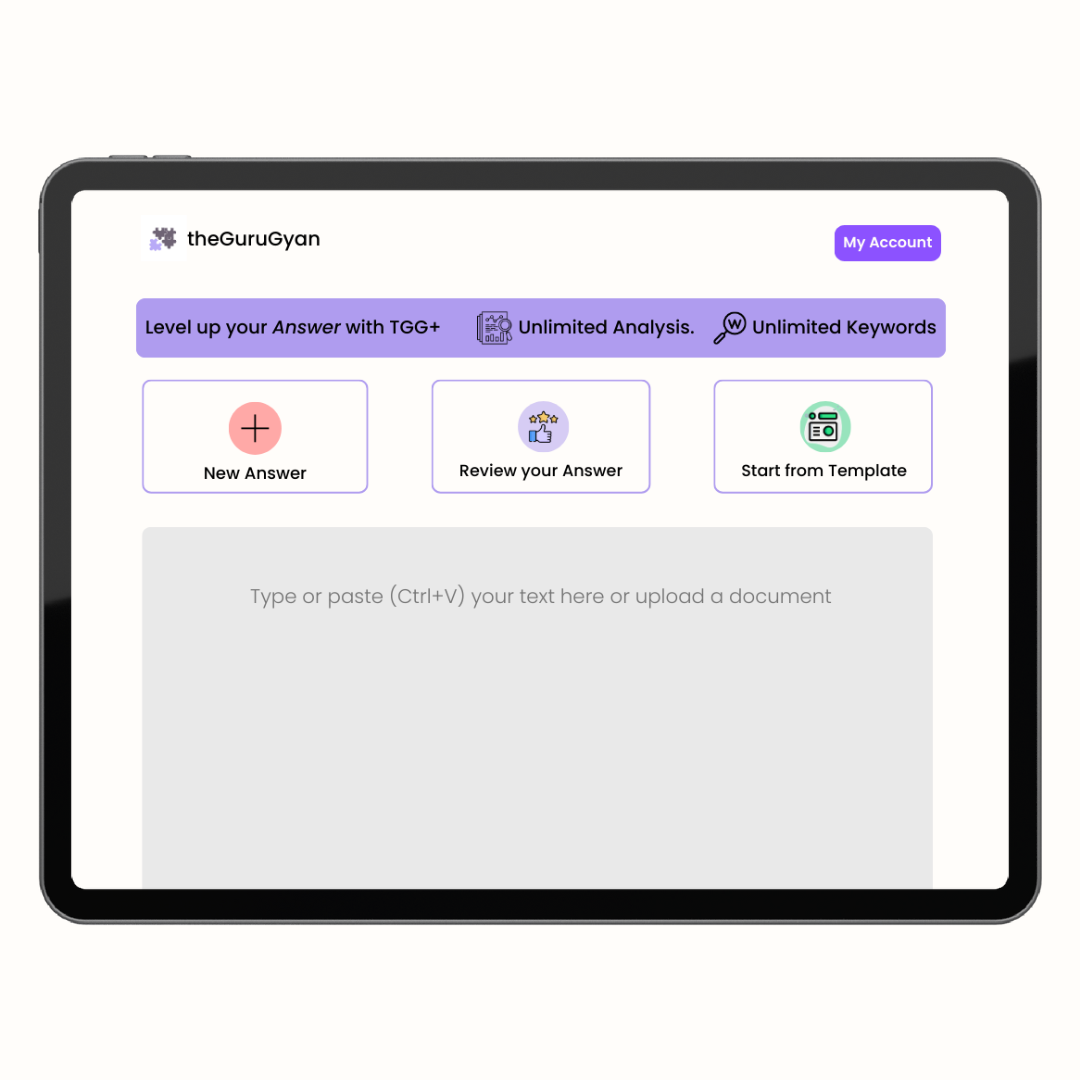
Executive Summary
~1.3M
UPSC Aspirants/yr
INR 3M
Annual S&M Budget
11%
Beta Free→Paid
52%
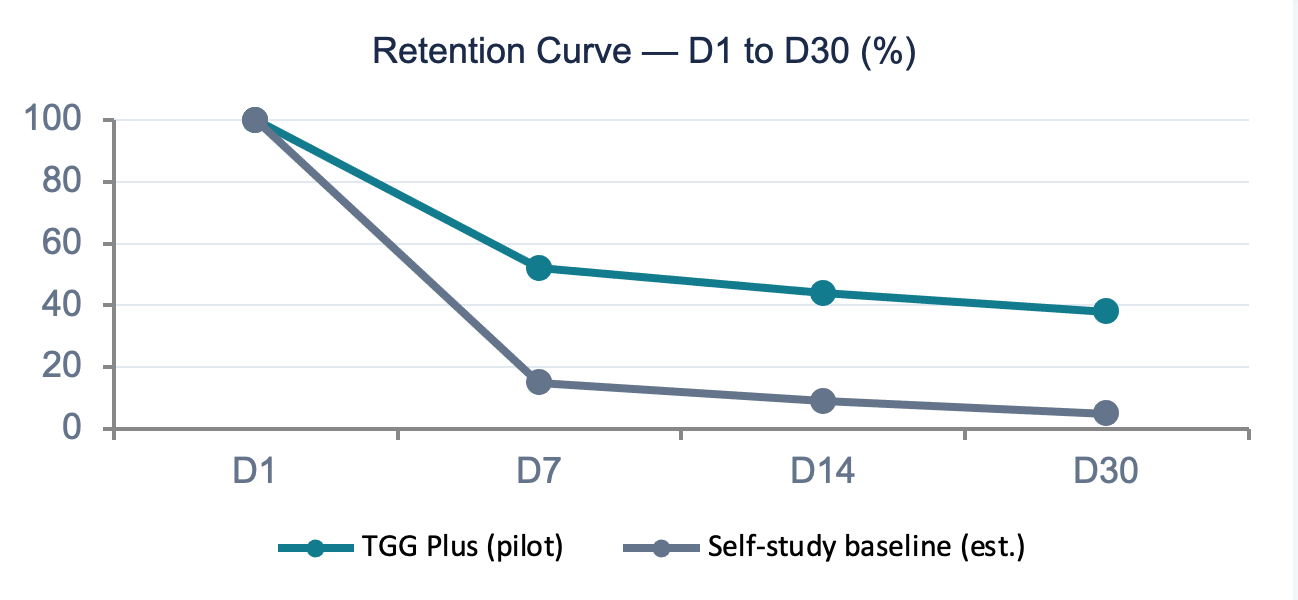
Beta D7 Retention
₹14.5M
M18 Cum. Revenue
Core Insight
87% of aspirants attempt <10 answers before Mains.
Coaching feedback takes 3–7 days. The habit collapses.
Beta Proved It
47-user pilot: 52% D7 retention, 6.2 submissions/user/week, 11% free→paid. Faculty: 4.1 hrs/week grading saved.
GTM Engine
Freemium habit → D30 upgrade → enterprise signal. 3-phase arc, INR 30L budget, 6 AEs for B2B.
Why We Win
Data moat (answer submissions), expert reviewer network effect, personal improvement history switching cost.
M1–3 Awareness · CPL ≤ ₹180 · 5K sign-ups
M4–6 Adoption · DAU/MAU ≥ 25% · 3 inst.
M7–9 Retention · LTV:CAC ≥ 3x · NPS ≥ 45
Market Opportunity
UPSC Aspirant Market | India 2022
~1.34M
Registered candidates, UPSC CSE 2024
Only 1.09%
Clear Prelims (14,627 candidates)
$ 6.5B
India coaching market 2024 (10.4% CAGR)
$ 437M
India online coaching 2024 (16.5% CAGR)
Primary Business Objective

Revenue Statbility
Establish recurring subscription models to ensure predictable cash flow.

B2B Partnership
Secure contracts with Coaching Institutes to drive volume.
Target: 100 Institute Partners

High Velocity B2B2C
Capture Aspirants via institutional
channels and direct self-service.
Target: 10,000 Active Users
Competitive Landscape
How TGG+ wins and loses in the real market, not in feature comparisons?
01 Data Moat
Answer Submission Database
Every answer submitted builds a proprietary dataset of aspirant writing patterns, common errors, score-correlated structures, and subject-specific language. This data improves feedback quality over time. Unacademy has video views — not granular written answer data. Copying the product is easy. Copying the data is impossible.
Time to replicate: 18–24 months minimum
02 Network Effect
Expert Reviewer Pool
TGG Plus curates a reviewer network of IAS/IPS-qualified experts who write and evaluate model answers. This pool is recruited, trained, and incentivised — not pluggable overnight. The reviewer quality is the core product. A new entrant starts with zero reviewed answers and zero reviewer reputation.
Time to replicate: 12–18 months
03 Switching Cost
Personalised Improvement History
Each student's historical answers, feedback received, and improvement trajectory is stored in their TGG profile. After 60–90 days of usage, the profile becomes a personal writing coach. Moving to a competitor means starting from scratch. This is the Duolingo streak mechanism — but with career-level stakes.
Cost grows exponentially with usage months
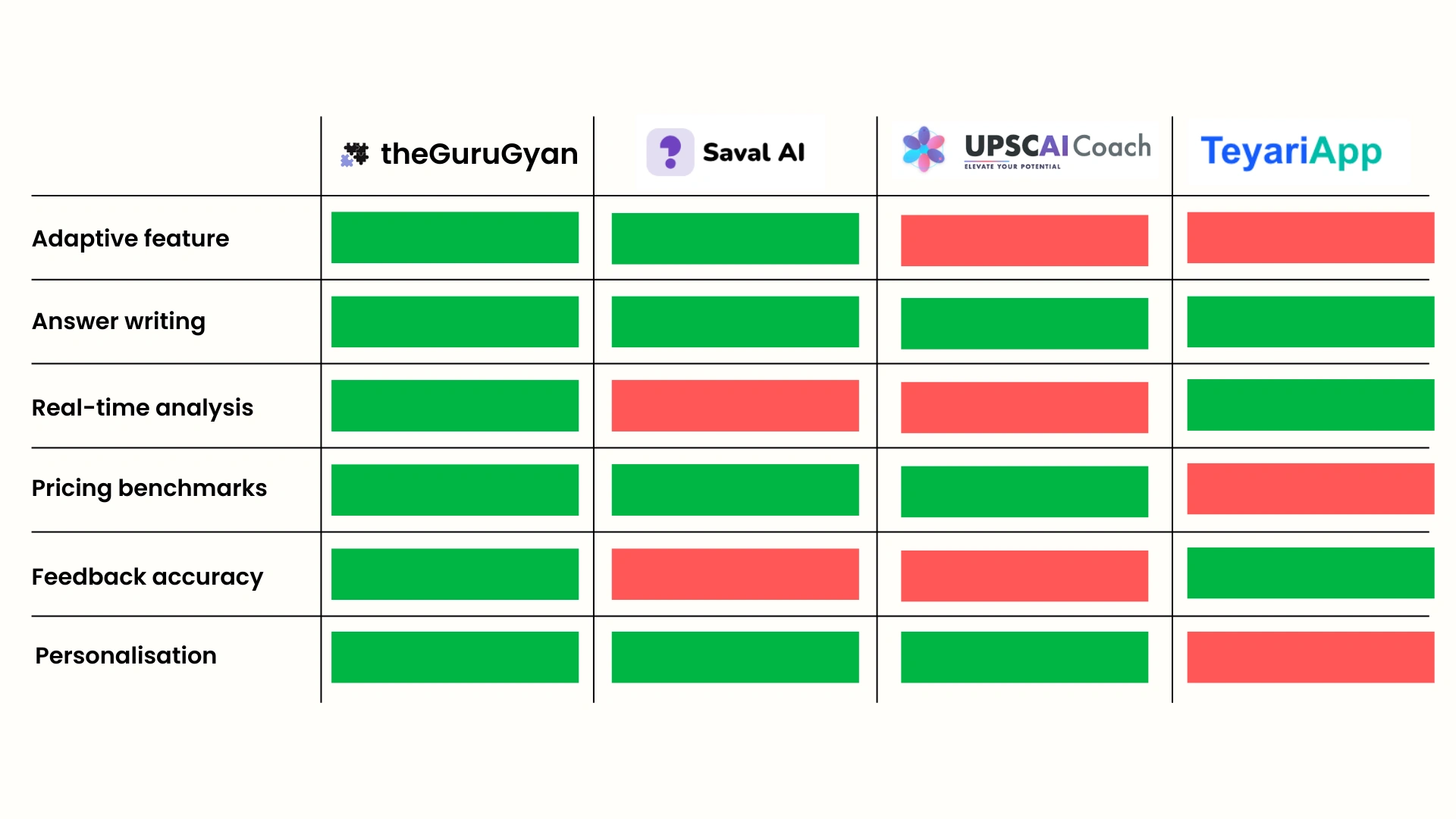
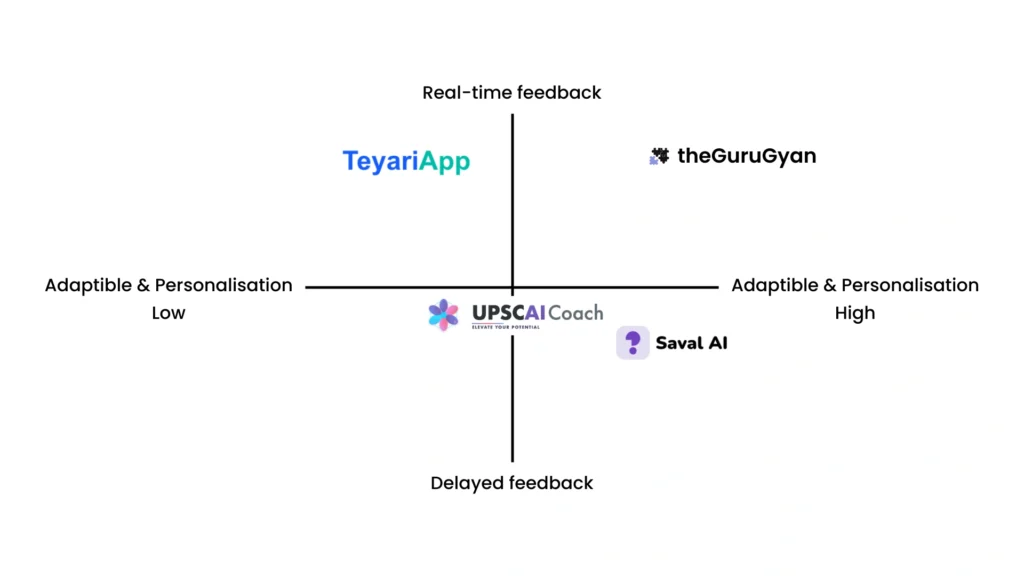
POSITIONING
"Your Daily Answer writing Practice Companion"
Primary Buyer (UPSC Coaching Institutes)
“Scalable, expert-led answer evaluation infrastructure for UPSC institutes.”
Value emphasis:
- Standardisation
- Operational efficiency
- Customisation
Secondary Buyer (UPSC Aspirants)
“Expert-reviewed UPSC answers and improve faster with
guidance.”
Value emphasis:
- Expert-led feedback
- Model Answers
- On the go
(What is NOT claimed)
- Market leader
- Highest success rate
- AI-powered
- Outcome claims (rank improvement, selection rates)
MESSAGING ARCHITECTURE
AUDIENCE | MESSAGES |
|---|---|
Institute | Reclaim 4+ hrs of grading time every week |
Aspirant
(Activate) | Write one answer. See your score in 24 hrs. |
Aspirant
(Retain) | You’ve improved 18 pts since Day 1. Don’t stop now. |
Aspirant
(Upgrade) | Your free answers run out today — your Mains doesn’t. |

Problems We Speak To:
- Platform rigidity frustration
- Inefficient and non-standard in-house content material
- Delayed analysis and feedback system
Tone Principles:
- No judgement
- No comparison
- No failure language
VALIDATION METHOD:
- Landing page A/B test: ‘Score in 24 hrs’ vs ‘Expert feedback’ — measure sign-up CVR over 2 weeks.
- Sales loop: Institute AEs tag objections weekly → PMM updates talk tracks monthly.
Product Walkthrough — How the Habit Loop Works
Submit → Reviewed → Feedback → Improve | Latency: <24 Hours
01
Student Submits Answer
02
Expert Review (<24h)
03
Structured Feedback Delivered
04
Improvement History
- Student selects a daily UPSC question
- Types answer (up to 250 words)
- Tags: subject, paper, difficulty
- Submitted to expert reviewer queue
- Avg submit time: 12 minutes
-
IAS/IPS-qualified reviewer assigned
-
Marks on 4-axis rubric: Structure,
-
Content, Language, Relevance
-
Adds inline comments on answer
-
Writes model answer for comparison
-
Score shown: e.g., 71/100
-
Radar chart: 4 axis breakdown
-
Colour-coded inline comments
-
Model answer side-by-side
-
‘Next question’ nudge triggered
-
30-day score trend graph
-
Subject-wise strength/gap map
-
Personal writing improvement %
-
Visible progress = retention engine
-
Upgrade prompt at Day 14/30
D7 Ret: 52%
(pilot)
Review in
<24 hours
NPS from
feedback: 58
D30 upgrade
rate: 11%
Reviewer QA Process:
- All reviewers are IAS/IPS-qualified or UPSC-cleared subject experts.
- Each answer rated by 1 primary reviewer.
- Answers <60/100 receive QA pass by senior reviewer.
- Reviewer NPS tracked monthly.
Target: 0 subjective bias complaints.
THE HABIT LOOP:
Daily Question Prompt
Answer Submitted
Expert Feedback <24h
Score + Model Answer
Improvement History
Next Day Nudge
JOBS TO BE DONE
Activation
The Anxious Self-Studier
WHEN
When I sit down to practise and stare at a blank page, unsure if my structure is even correct,
I WANT
I want to submit one answer and receive a score with specific expert feedback within 24 hours,
SO WHAT
So that I prove to myself I can do this and build the daily habit.
↗ 87% of aspirants attempt <10 answers before Mains. Habit collapses without fast feedback.
B2B Adoption
The Institute Faculty Head
WHEN
When I'm spending 8–10 hrs/week grading answers and can't give individualised feedback at scale,
I WANT
I want a platform that evaluates answers on a consistent rubric and delivers structured feedback automatically,
SO WHAT
So that I reclaim grading time, standardise quality, and demonstrate measurable student progress.
↗ Beta: 4.1 hrs/week grading saved per institute. ROI 131% in Year 1 at ₹1.2L/yr.
Retention & Upgrade
The Plateaued Repeater
WHEN
When I've been writing for 3 weeks but can't tell if I'm improving — scores feel random and I don't know what to fix,
I WANT
I want a personal history showing my score trend by subject and highlighting my repeating weak spots,
SO WHAT
So that my effort feels like it's compounding — and I can justify upgrading before Mains.
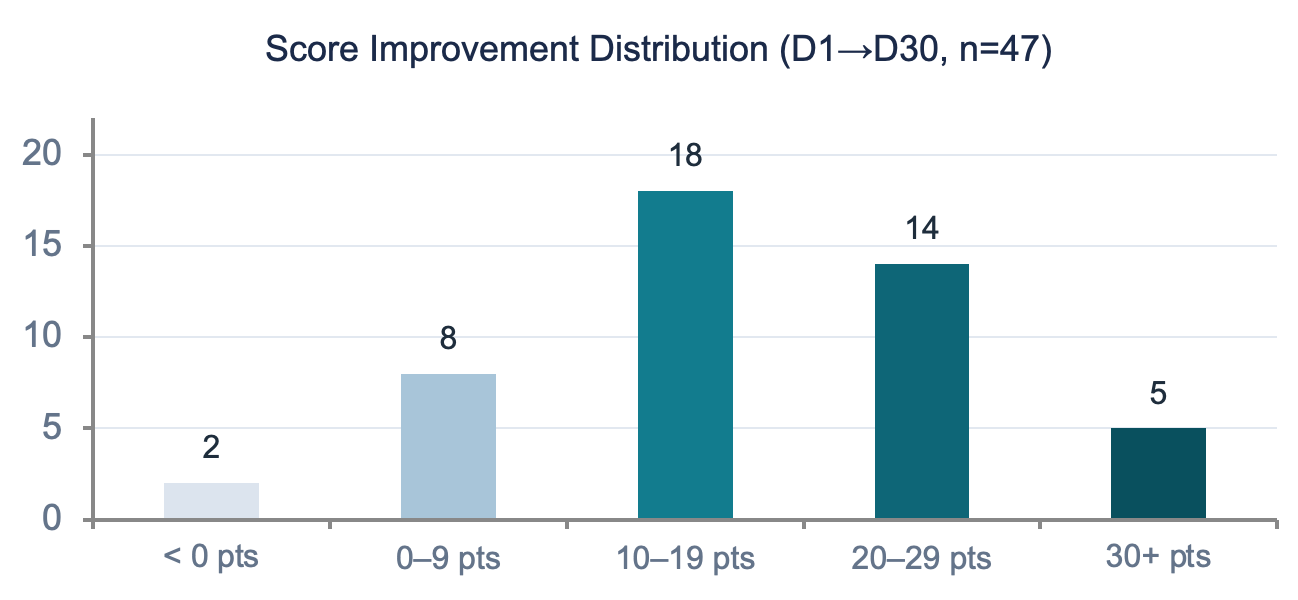
↗ Beta: Avg score Δ +18 pts (D1→D30). Improvement history is the primary D30 upgrade trigger.
Institute Pilot Case Study — Sales Artifact
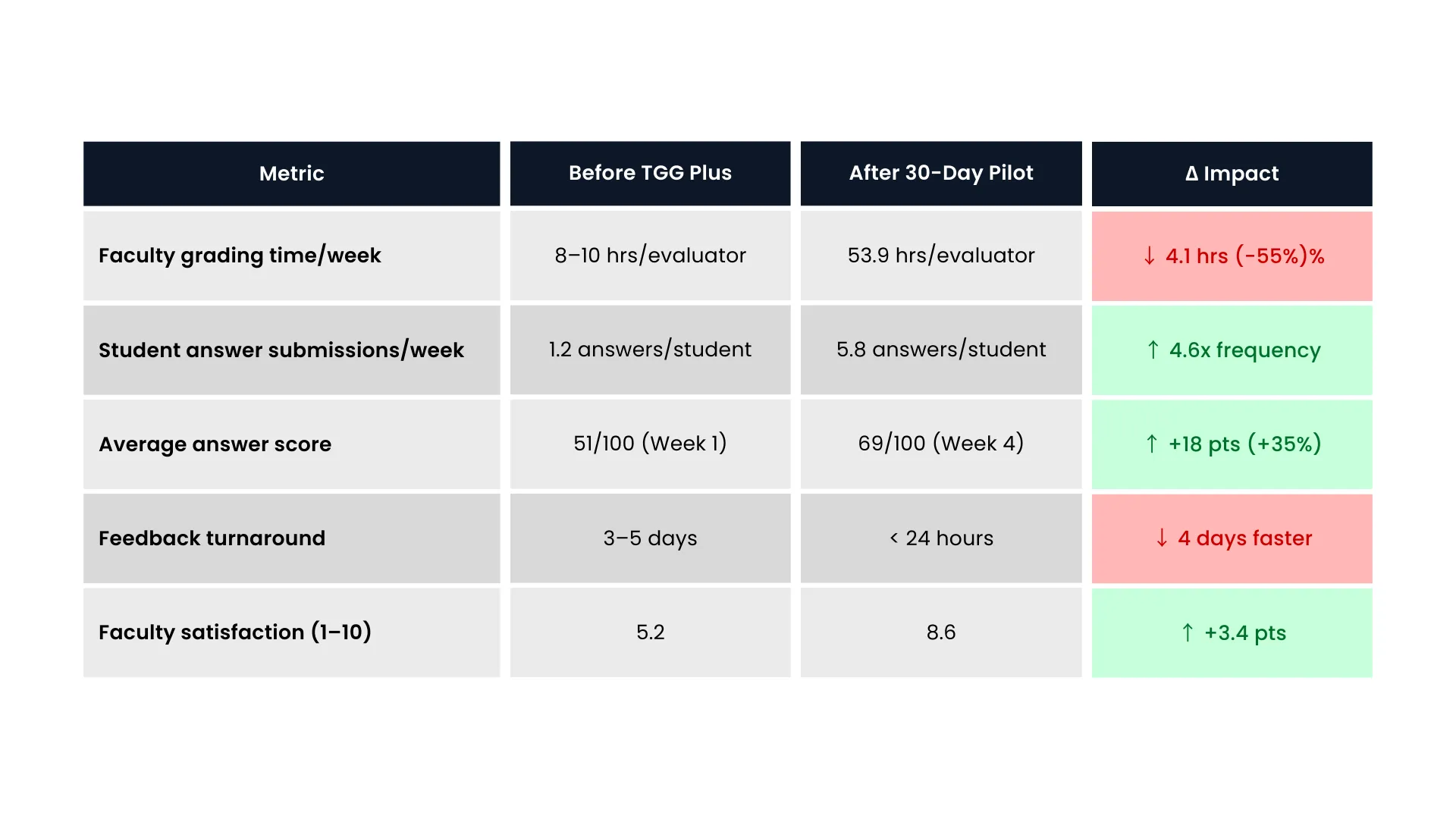
Beta Institute: Delhi Tier-1 Coaching · 23 Students · 30-Day Pilot
Institute Profile: Mid-size UPSC coaching (Delhi NCR). 23 students enrolled in Mains batch. Faculty: 2 senior evaluators.
Pain point: manual answer evaluation consuming 8–10 hours/week per evaluator. Pilot duration: 30 days.
ROI CALCULATION
- Faculty time saved: 4.1 hrs/week × 2 evaluators × 48 weeks = 394 hrs/year
- Faculty hourly rate (est. ₹400/hr for senior UPSC faculty): 394 × ₹400 = ₹1,57,600
- Annual cost of TGG Plus Standard: ₹1,20,000
- Net annual saving: ₹37,600 | ROI: 131% in Year 1
“We saved nearly half our grading time. Our students are writing 5x more answers and the quality scores are visibly improving. We’re signing the annual plan.”
— HOD, UPSC Mains Batch, Delhi NCR (Pilot cohort)
Pricing Strategy
Tiered Freemium + Subscription | B2B2C Model
STUDENT PRICING
ENTERPRISE PRICING (INSTITUTES)
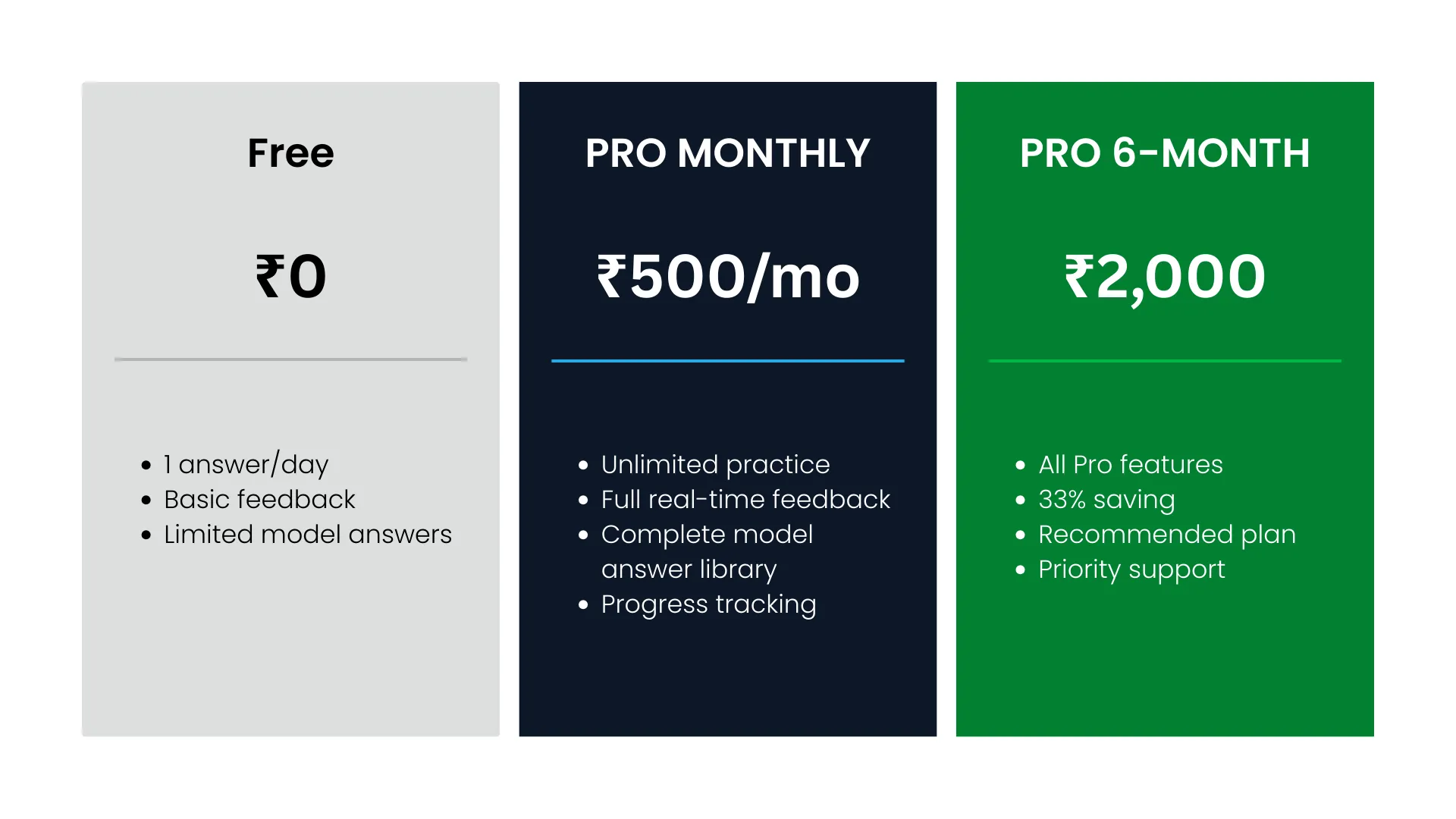
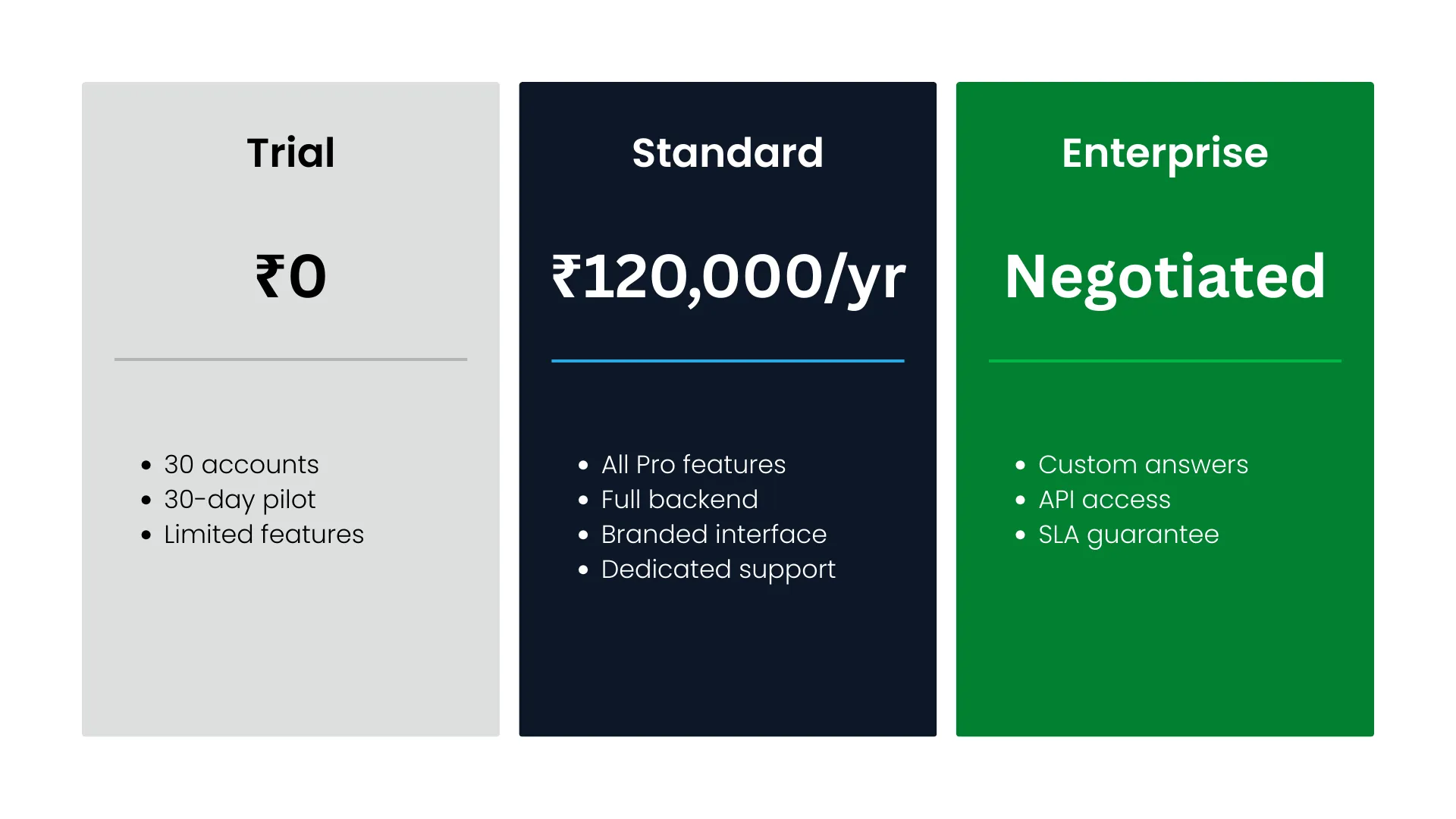
Pricing Rationale + ROI: ₹500/mo = <0.5% of annual coaching spend. 6-month plan aligns to UPSC Mains cycle. Enterprise ₹1.2L/yr → institute ROI 131% in Year 1 (4.1 hrs/week grading saved × ₹400/hr faculty rate = ₹1.57L saving). Beta pilot institute converting to annual plan.
Pre-Launch | Months 1–3: Awareness & Acquisition
Phase 1 GTM Execution Plan
Week 1–2
Week 3–4
Month 2–3
Foundation Setup
Soft Launch & Test
Scale & Qualify
- Google Ads structure (Search + Display)
- Meta Ads audience: UPSC interest, 21–28yr
- Landing page: free-tier sign-up optimised
- Tracking pixels, UTM, conversion goals set
- A/B test 2 creatives per channel
- Free tier live (1 answer/day limit)
- Sales team briefing: ICP + talk tracks
- Monitor CPL daily; pause if >₹200 at Day 7
- Scale winners (target CPL ≤ ₹180)
- Sales team: 50 institute cold outreach
- Content: ‘Daily Answer Writing’ social series
- Collect beta feedback → product backlog
Phase 1 KPIs: CPL ≤ ₹180 | ROAS ≥ 2x | Free sign-ups: 5,000 in 90 days | Institute demos: 30+ | D7 retention: 40% (beta baseline: 52%)
Launch | Months 4–6: Adoption & Engagement
Activation → Feature Depth → First Revenue
STUDENT ACTIVATION
INSTITUTE ACTIVATION (B2B)
30-Day Behaviour Funnel
Track D1, D7, D14, D30 retention. Trigger in-app nudges at each drop-off. Beta baseline: 52% D7. Target ≥ 40% at scale.
SQL Qualification
6 AEs: inbound + outbound. Target 15–20 demos/month. SQL: HOD/Owner + 10+ student cohort. Sales cycle: 4 weeks avg.
Feature Unlock Emails
Drip sequence: Day 3 → Model Answer preview. Day 7 → Expert feedback tease. Day 14 → Upgrade prompt with social proof.
Demo to Pilot
30-day free pilot (Pro features). Lead with beta outcomes: 52% D7 retention, 4.1 hrs/week grading saved.
Conversion to Paid
Target 5–7% free-to-paid in 60 days. Beta achieved 11%. Conservative target accounts for scale effects.
Enterprise Close
Target: 3 closures at ₹1.2L/yr by M6. Share pilot outcome report. ROI calc: time saved vs price.
Phase 2 KPIs: DAU/MAU ≥ 25% | Answers/user/week ≥ 4 | NPS ≥ 35 | Institute pilots: 5 | First paid student MRR positive
Post-Launch | Months 7–9: Retention & Advocacy
Deepening LTV | Building the Moat
Referral Programme
Student refers → both get 1 month free. Target: 15% new sign-ups from referral. Referral CAC = 40% of paid ad CAC.
Topper Testimonials
Video testimonials from beta users showing score improvement. Meta/YouTube retargeting to warm audiences.
Renewal Loop
30-day pre-renewal email. 'Your 6-month writing progress' personalised report at renewal trigger. Target: 65%+ renewal.
Institute Renewal & Upsell
Re-engage 3 enterprise clients from M6. Usage reports showing student outcomes. Upsell to multi-year / larger cohort.
Community Flywheel
'TGG Mains Circle' — peer community for subscribed users. Builds switching cost and advocacy.
NPS & Feedback Loop
Monthly NPS pulse. Qualitative interviews with top 5% engaged users. Feedback → product roadmap Q4.
Phase 3 KPIs: CAC ≤ ₹800 | LTV:CAC ≥ 3x | Renewal ≥ 65% | Referral share ≥ 15% | NPS ≥ 45 | MRR growth ≥ 15% MoM
Sales Enablement Strategy
6-Person In-House Sales Team | Institute GTM
PROSPECT — ICP: SMB institutes, 10–200 students, Tier 1–2 cities. Target list: 200 institutes.
OUTREACH — Cold call + LinkedIn. Hook: 'See how 23 students improved answer scores 35% in 30 days at [similar institute]'.
DEMO — 30-min product demo. Lead with beta case study: 4.1 hrs/week saved, 5.8x submissions, 131% ROI. Leave-behind: ROI calculator.
CLOSE — ₹1.2L/yr. Share pilot outcome report. ROI calc shows ₹37K net saving in Year 1. Target: 3 closes M6, 8 closes M9.
Sales Toolkit: Institute 1-pager | Beta case study (Delhi NCR institute, 131% ROI) | ROI calculator (evaluation time saved) | Demo deck with pilot data | Talk tracks per buying role | Pilot onboarding guide
SALES Collaterals

Quick-reference guides for handling objections regarding technology adotion and cost.

Case studies demonstrating improved exam readiness and selection rates.

Student count and test frequency. Hours and money saved anually.
Channel & Distribution Strategy
Channel Strategy · KPI Framework · Every Number Has a Source
Google Search
High-intent capture: 'UPSC answer writing platform'
Budget: 35% / ₹10.5L
CPL: ≤₹180
Meta (FB/IG)
Awareness: UPSC interest, 21–28yr, retarget blog visitors
Budget: 25% / ₹7.5L
CPL: ≤₹200
Reddit r/UPSC + ForumIAS
Weekly answer-writing challenge posts; AMA with reviewers
Budget: 0 (5% headcount)
CPL: ₹0–30
Telegram / WhatsApp groups
Free daily question drops → TGG+ link for model answer
Budget: 0 (community mgr)
CPL: ₹0
YouTube (answer teardowns)
5-min review videos: 'UPSC answer scored live' format
Budget: 10% / ₹3L
CPL: ₹40–80
Sales (6 AEs)
Institute outbound + referral programme: ₹500 credit/student referred
Budget: 30% / ₹9L
CPL: ₹800–1200
DIGITAL CHANNEL MIX
Channel | Targeting | Share | Annual |
|---|---|---|---|
Google Search | UPSC keywords, high-intent | 35% | ₹1.05M
|
Meta (FB/IG)
| Interest: UPSC, 21–28yr | 25% | ₹750K
|
Content Mktg
| Blog, YouTube, community | 10% | ₹300K |
Sales (6 AEs) | Institute outbound, demos | 30% | ₹900K |
HOW TARGETS WERE DERIVED
Metric | Target | Source |
|---|---|---|
CPL | ≤ ₹180
| Google KW Planner: ₹45–80 CPC × 3 clicks
|
Free→Paid
| 5 – 7% | Pathmonk 2024: EdTech 5–8% (beta: 11%) |
D7 Retention | 40% | Amplitude 2023 habit-app range (beta: 52%) |
LTV:CAC | ≥ 3x | SaaS Capital 2024 health threshold |
Referral | 15%
| EdTech referral benchmarks 10–20% |
NPS M6/M9
| 35 / 45 | Satmetrix 2023: SaaS median 34 |
INTERNAL ALIGNMENT & CROSS-FUNCTIONAL FRAMING
GTM ACTIVITY | PRODUCT | PMM | SALES & MARKETING | DATA / ENGG. | TIMELINE |
|---|---|---|---|---|---|
Habit loop feature (streaks, nudges) | R | C | I | A | M1–3 |
Positioning & messaging | C | R | I | I | M1–2 |
Landing page copy + A/B test | I | R | A | C | M2–3 |
Launch creative + campaign | I | R | A | I | M3–4 |
Institute demo deck & ROI calc | I | R | A | I | M2–3 |
Beta → scale on-boarding flow | A | C | R | R | M4–5 |
Churn cohort analysis | C | R | I | A | Monthly |
Quarterly GTM review (QBR) | A | R | C | C | Quarterly |
Product roadmap from market signals | A | R | C | I | Monthly |
R Responsible
A Accountable
C Consulted
I Informed
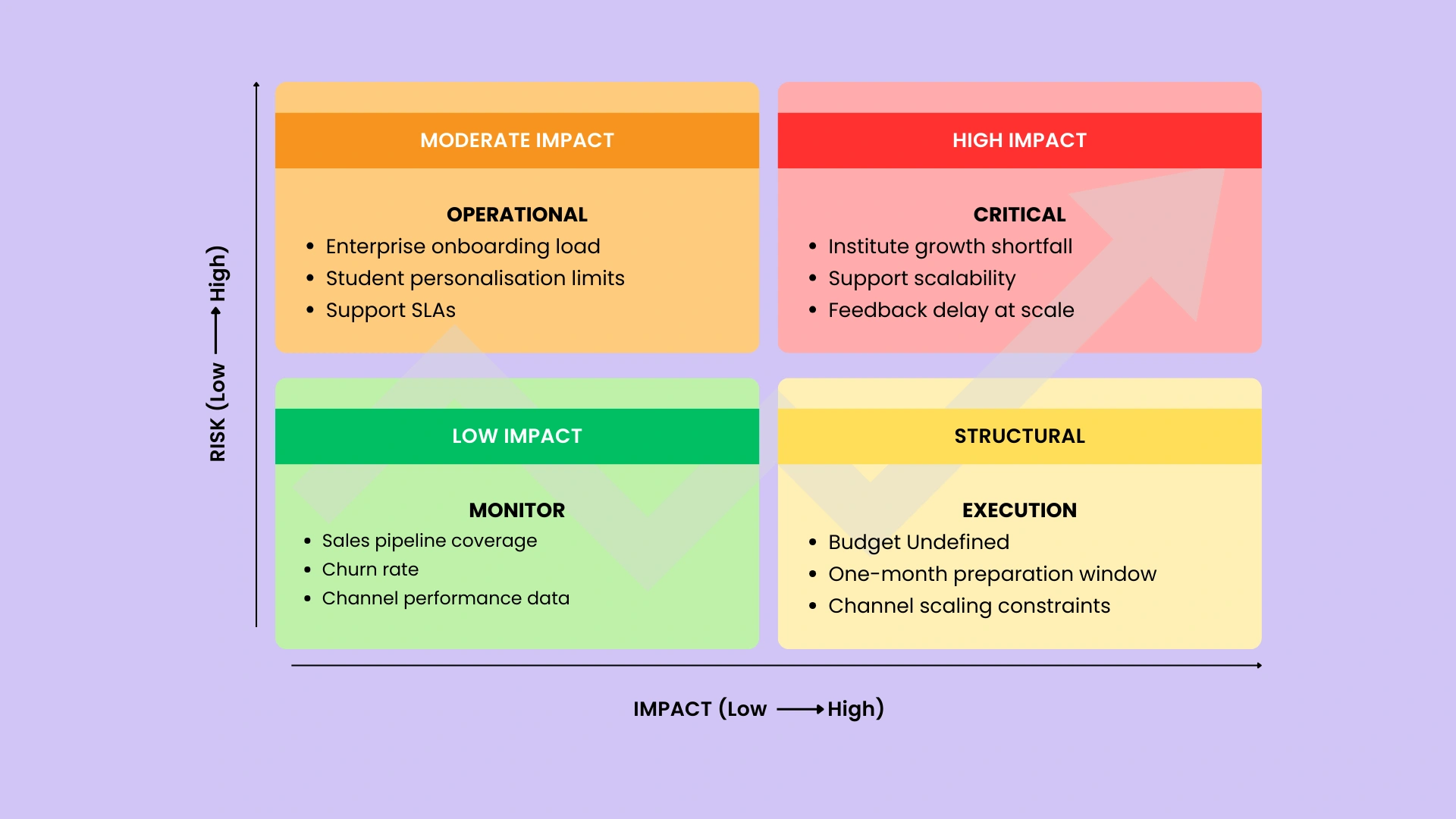
RISK Assessment
Financial Model — Sensitivity, Break-even & Feedback
Assumptions · 3-Scenario Sensitivity · What Would Break the Model
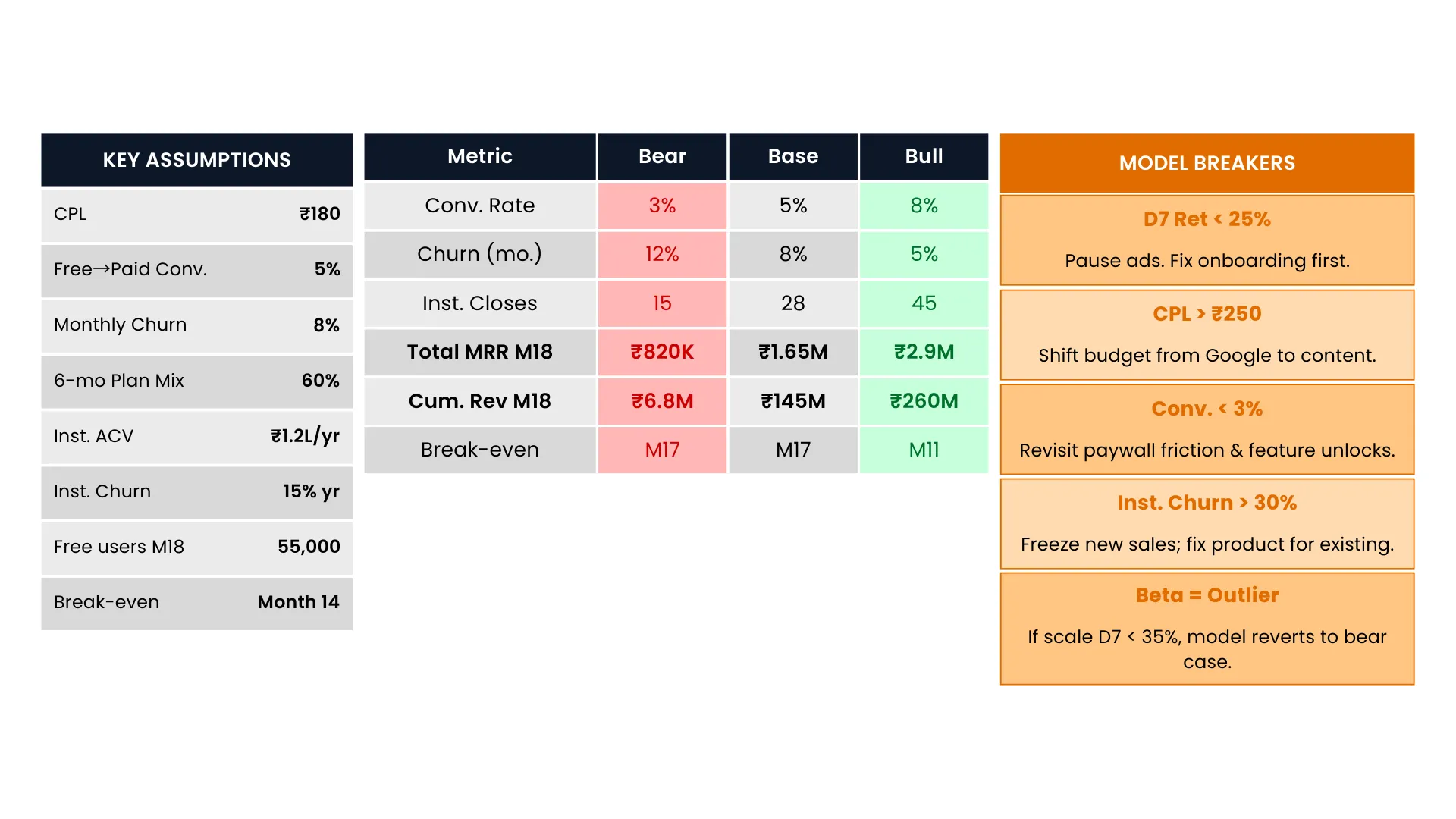
CONTINUOUS FEEDBACK ENGINE: Collect (NPS, interviews, in-app) → Analyse (churn cohorts, drop-off maps) → Act (roadmap, A/B tests) → Measure (retention Δ, NPS Δ) → QBRs with institutes.
01 Habit Before Conversion
30-day funnel proves value before paid ask. Insight → product → habit → upgrade.
02 Every Target Has a Source
CPL ₹180 from KW CPC. D7 40% from habit benchmarks. LTV:CAC 3x from SaaS Capital.
03 The Risk Is Retention
₹18L in ads is solvable. If D7 < 25% at M2 end, pause spend. Fix onboarding first.
Institute Pilot Case Study — Sales Artifact
Beta Institute: Delhi Tier-1 Coaching · 23 Students · 30-Day Pilot
Institute Profile: Mid-size UPSC coaching (Delhi NCR). 23 students enrolled in Mains batch. Faculty: 2 senior evaluators.
Pain point: manual answer evaluation consuming 8–10 hours/week per evaluator. Pilot duration: 30 days.
ROI CALCULATION
- Faculty time saved: 4.1 hrs/week × 2 evaluators × 48 weeks = 394 hrs/year
- Faculty hourly rate (est. ₹400/hr for senior UPSC faculty): 394 × ₹400 = ₹1,57,600
- Annual cost of TGG Plus Standard: ₹1,20,000
- Net annual saving: ₹37,600 | ROI: 131% in Year 1
“We saved nearly half our grading time. Our students are writing 5x more answers and the quality scores are visibly improving. We’re signing the annual plan.”
— HOD, UPSC Mains Batch, Delhi NCR (Pilot cohort)
Beta Pilot Outcomes — Evidence of Impact
47 Students · 3 Institutes · 45-Day Cohort · Pre-Launch
Pilot Design: 45-day closed beta.
- 47 students (self-selected via TGG waitlist).
- 3 coaching institute cohorts.
- Free tier with full expert feedback enabled.
Outcome tracked:
- Answer quality score (structure, content, language, relevance),
- D7/D14/D30 retention, submissions/user/week.
52%
D7 Retention
vs ~15% self-study est.
6.2
Answers/User/Week
Habit formed by Day 7
11%
Free → Paid Conv.
vs 5–8% EdTech bench
+18 pts
Avg Score Δ (D1→D30)
Out of 100-pt rubric
4.1 hrs
Faculty Grading Saved/wk
Per institute (3 cohorts)
"Before TGG Plus I'd write 2 answers a week. Here I've done 38 in 6 weeks and I can see my scores improving."
The feedback is specific, not generic. — UPSC aspirant, Delhi, IAS 2022 attempt